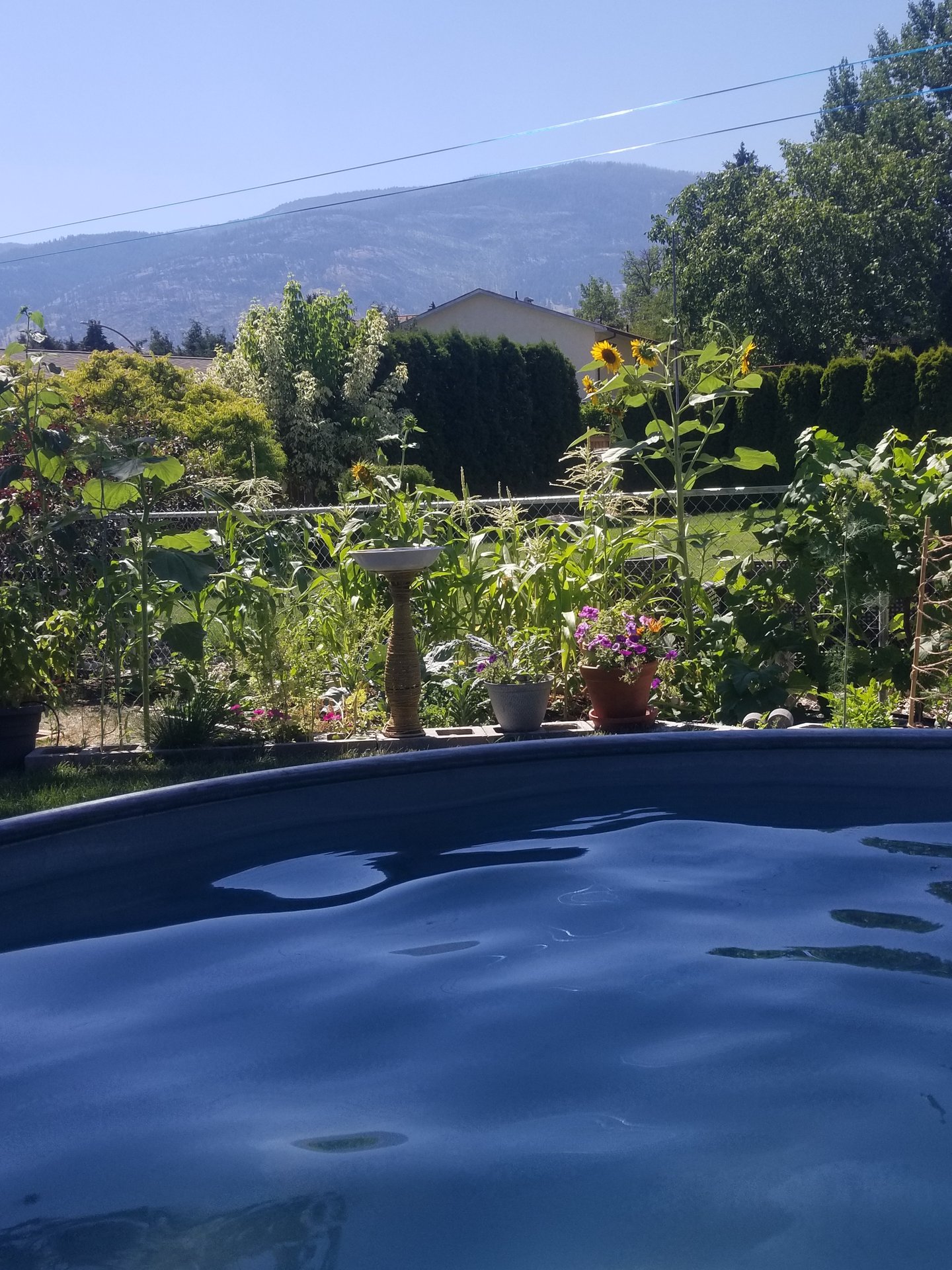
Two days ago, it rained in Oliver.
I know that sounds like the opening line of a very boring novel, but if you live in the South Okanagan, you understand the emotional weight of that sentence. It. Rained. Real rain. Soaking, ground-drenching, puddle-making, smell-the-earth rain. Twenty-four hours of it.
My garden, which has been looking at me with the quiet desperation of a houseplant owned by a forgetful teenager, suddenly exploded. Things grew overnight. Literally overnight. And the mushrooms — oh, the mushrooms — popped up across my yard like tiny umbrellas at a very enthusiastic fungal convention.
I stood in my garden the next morning in my rubber boots and almost cried.
Here’s the thing about that rain, though. It was a gift. And like most gifts we receive in a drought, it disappeared faster than we deserved.
Because the Okanagan is in trouble. Real trouble. As of May 1st, the Okanagan snowpack sits at 31% of normal — not just below average, not just concerning, but a record-shattering historic low. All-time low measurements were recorded this spring at Silver Star Mountain, Mount Kobau, and Islaht Lake. The region has been in some form of drought since fall 2022. We are heading into a summer with a long-range forecast of above-normal temperatures, and the water we normally count on being stored in the mountains? It’s mostly gone.
I had to start watering my garden in February. February. In Canada.
Water restrictions are coming. Maybe those two days of rain buy us a little grace — but make no mistake, we need a lot more than two days.
In the face of drought in the Okanagan, municipal planning continues to push the notion that what we need is to replace our plants, trees and grass with something that holds heat and repels water.
Rocks.
Remove the grass. Pull out the plants. Put down the weed mat. Cover it in gravel. Done. Water-wise! Low maintenance! Problem solved!
I have watched this happen, development after development, yard after yard. Homes ringed by pale gravel, maybe a sad ornamental grass in the corner, a couple of boulders for “texture.” The town plan for new developments essentially mandates it. Goodbye lawn. Hello moonscape.
And I understand the impulse. I do. Grass is thirsty. Lawns are a colonial hangover from English estates that have absolutely no business existing in a high desert. I am not arguing for the Kentucky bluegrass lawn. That ship has sailed, as has most of our snowpack.
But here’s what the well-meaning councillors got catastrophically wrong:
When that glorious rain fell two days ago, what happened to the water that landed on a gravel yard? It ran. It sheeted off. It headed for the storm drain and was gone within hours. What happened to the water that landed in my garden — on my soil, under my mulch, around my plant roots, into my compost? It stayed. It sank. It was caught.
This is not a radical permaculture idea. This is basic hydrology. Plants and soil are a water storage system. Roots create channels. Organic matter acts like a sponge. Mycorrhizal networks — those fungal webs that explain why my mushrooms showed up so enthusiastically — help move and retain moisture through the soil. A living landscape is infrastructure. It catches every drop and holds it.
A gravel yard is the opposite of infrastructure. It’s a drainage system. Every raindrop that falls on it is immediately evicted.
And it gets worse. Studies show that rock-heavy xeriscaping can raise surface and air temperatures by over five degrees. Five degrees. In Oliver. In July. Think about that. And because heat accelerates evaporation, those rocks aren’t just failing to catch water — they’re actively stealing it from the soil and plants around them. The rocks that were installed to save water are making your water problem worse.
We traded a living system for a decorative one. And we wrote it into the building code.
So what should we have done? What can we still do?
Here’s what actually works in a dry climate:
Plant ground covers, not gravel. Creeping thyme, sedum, native bunch grasses — these are low water, low maintenance, and they cover the soil, keep it cool, and let rain infiltrate. They don’t need a weed mat. They are the weed mat.
Plant trees. Especially fruit trees. The Okanagan grows the best stone fruit in the country. An apricot tree shades the ground, cools the air through evapotranspiration, feeds you, feeds the birds, and catches water with its root system. It is doing more ecological work than a decorative boulder will ever do.
Use organic mulch, not rock. Wood chip mulch keeps soil cool, retains moisture, breaks down into nutrients, and encourages exactly the kind of fungal activity that makes soil alive and absorbent. It does everything gravel does aesthetically, and everything gravel fails to do ecologically.
Catch the rain when it comes. I have 940 litres stored in rain barrels and a splash pool right now. It’s not enough for the whole summer, but it’s something. Every litre I catch in a barrel is a litre I don’t pull from the municipal system during restrictions. This is the closed loop — catch it, store it, use it slowly.
Rethink the bylaw. No grass lawns for new developments? Fine. Great, even. But the replacement should be living landscape — drought-tolerant native plants, food gardens, ground covers, trees — no rocks and gravel. The policy got the problem right and the solution backwards.
The mushrooms in my yard this morning are not just a charming post-rain detail. They are evidence. They are proof that my soil is alive, that the water was caught, that the system worked. A gravel yard doesn’t get mushrooms. It gets weeds poking through the mat and heat radiating back at your face.
We live in a desert. We have always lived in a desert. The plants that evolved here know how to live in a desert. Our job is to stop fighting that and start working with it — to catch every drop, store every litre, and plant every square foot we can.
The rain came. Did your yard catch it?